
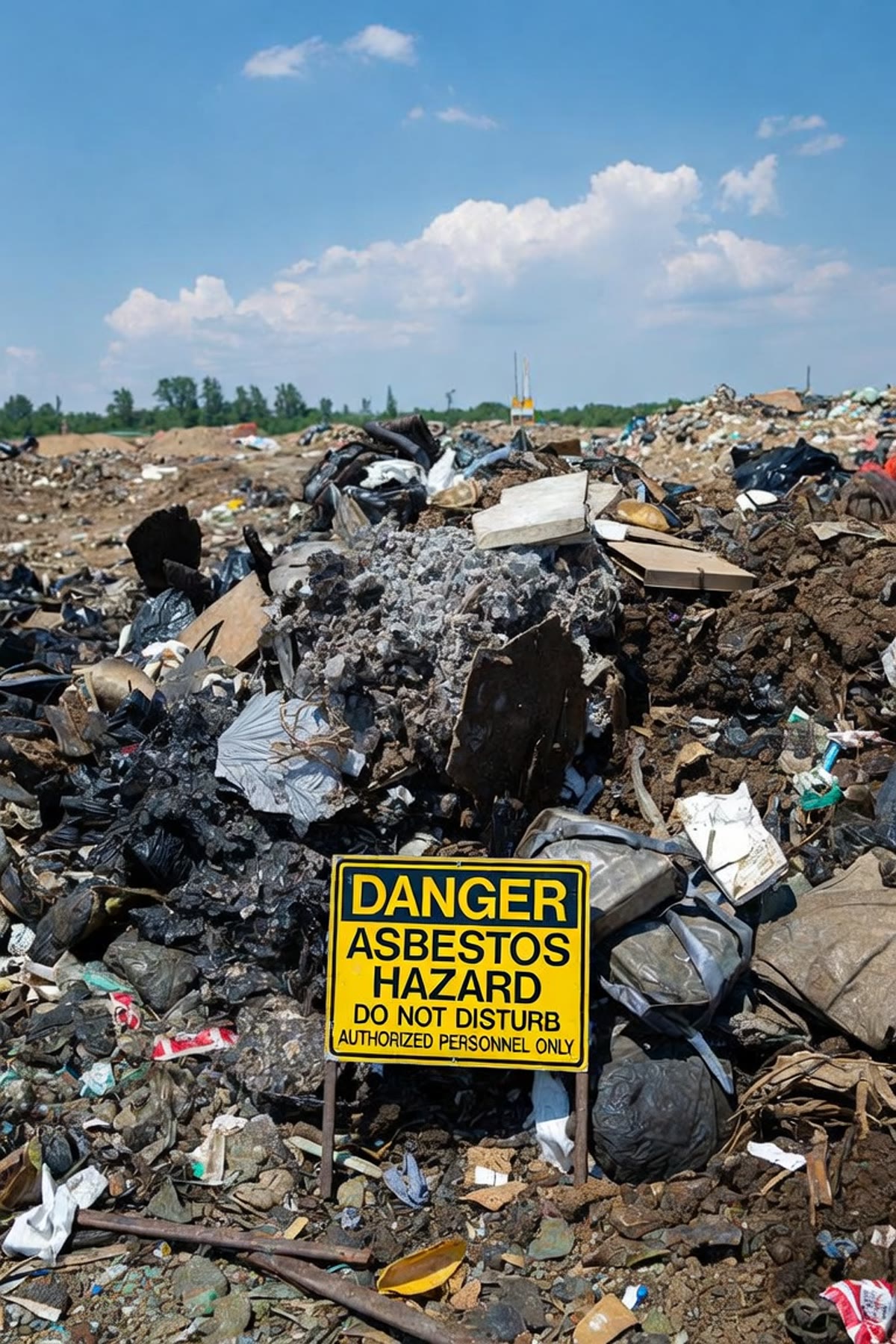
Asbestos shows up at the gate more often than people expect — old roofing, vermiculite insulation, vinyl floor tile backing, transite siding from a farmhouse built before 1990. Not every landfill in Manitoba is authorized to accept it, and the ones that are have to handle it according to a specific set of rules.
It can be hazardous or non-hazardous, depending on the material
One detail that surprises a lot of haulers: asbestos-containing material (ACM) isn't automatically classified as hazardous waste under Manitoba's Hazardous Waste Regulation. Whether it's designated hazardous or non-hazardous depends on the specific material and how it's been handled. What doesn't change, regardless of classification, is the underlying safety concern — asbestos fibres are a recognized cause of asbestosis, lung cancer, and mesothelioma when inhaled, and the material has to be managed accordingly from the moment it's disturbed.
Not every landfill is authorized to accept asbestos or ACM. Before you load a truck, confirm directly with the receiving site whether your specific material and quantity are within what they're permitted to take. Don't assume a landfill that takes general construction and demolition debris is automatically equipped to take ACM.
Friable vs. non-friable: the distinction that drives everything else
The single most important classification a hauler needs to understand before bringing ACM anywhere is whether the material is friable or non-friable.
- Friable material can be crumbled, pulverized, or reduced to powder by hand pressure. Sprayed-on fireproofing, some pipe insulation, and damaged vermiculite fall into this category. Friable ACM releases fibres far more readily and is treated with the highest level of caution.
- Non-friable material — intact transite panels, most vinyl floor tile, cured asbestos-cement siding — holds its fibres bound in a solid matrix under normal conditions. It's still asbestos, and it still has to be managed as such, but the handling requirements differ because the risk of airborne release is lower as long as the material stays intact.
Manitoba's Workplace Safety and Health Regulation, under Part 37, sets out three work classifications — generally referred to as Type 1, 2, and 3 — that scale with this same friable/non-friable distinction and the likelihood of fibre release during the work itself. Type 3 is the highest-risk category, reserved for friable material where fibre release during the work is expected, and it carries the most stringent control measures, including mandatory advance notification to Workplace Safety and Health.
What has to happen before it ever reaches the gate
By the time ACM arrives at a landfill, several regulatory steps should already be behind it:
- Identification. A person competent in identifying ACM has to complete an asbestos inventory wherever the material is suspected, before any work that could disturb it begins.
- Notification. For work expected to release ACM into the air, Workplace Safety and Health must be notified — current guidance specifies a window of at least five calendar days, and not more than ten, before the work starts.
- Containment and packaging. Asbestos waste is double-bagged in sealed, dust-tight bags — commonly specified as 6-mil polyethylene — or placed in leak-proof drums, with appropriate warning labels affixed.
- Wet methods during removal. Keeping the material wet during handling is one of the standard control measures used to suppress airborne fibre release, particularly when the material can't be fully contained ahead of disposal.
What we look for at the receiving end
When a load of ACM arrives, the gate process is built to confirm — not assume — that the material has been packaged correctly:
- Bags or drums sealed and intact, not torn or leaking;
- Clear, legible warning labels on every container, not just the load as a whole;
- A description of the waste accompanying the load, consistent with what asbestos abatement work procedures require haulers to provide; and
- The driver and crew aware of what they're transporting — supervision of the actual dumping process is part of standard practice precisely because the person operating the equipment needs to know the hazardous nature of the material going into the ground.
Material that doesn't meet these conditions gets refused at the gate rather than buried improperly. It's a more disruptive outcome for the hauler, but a far better one than trying to remediate a release after the fact.
Employers are expected to maintain asbestos monitoring records for a 30-year retention period under current Workers Compensation Board guidance — far longer than most general construction paperwork. If your project disturbed ACM, build that retention requirement into your records system from day one rather than trying to reconstruct it years later.
Asbestos disposal isn't complicated once you understand the friable/non-friable distinction and follow the packaging requirements through — but skipping a step doesn't just risk a rejected load. It risks an airborne fibre release that the next several decades of monitoring records exist specifically to prevent.