
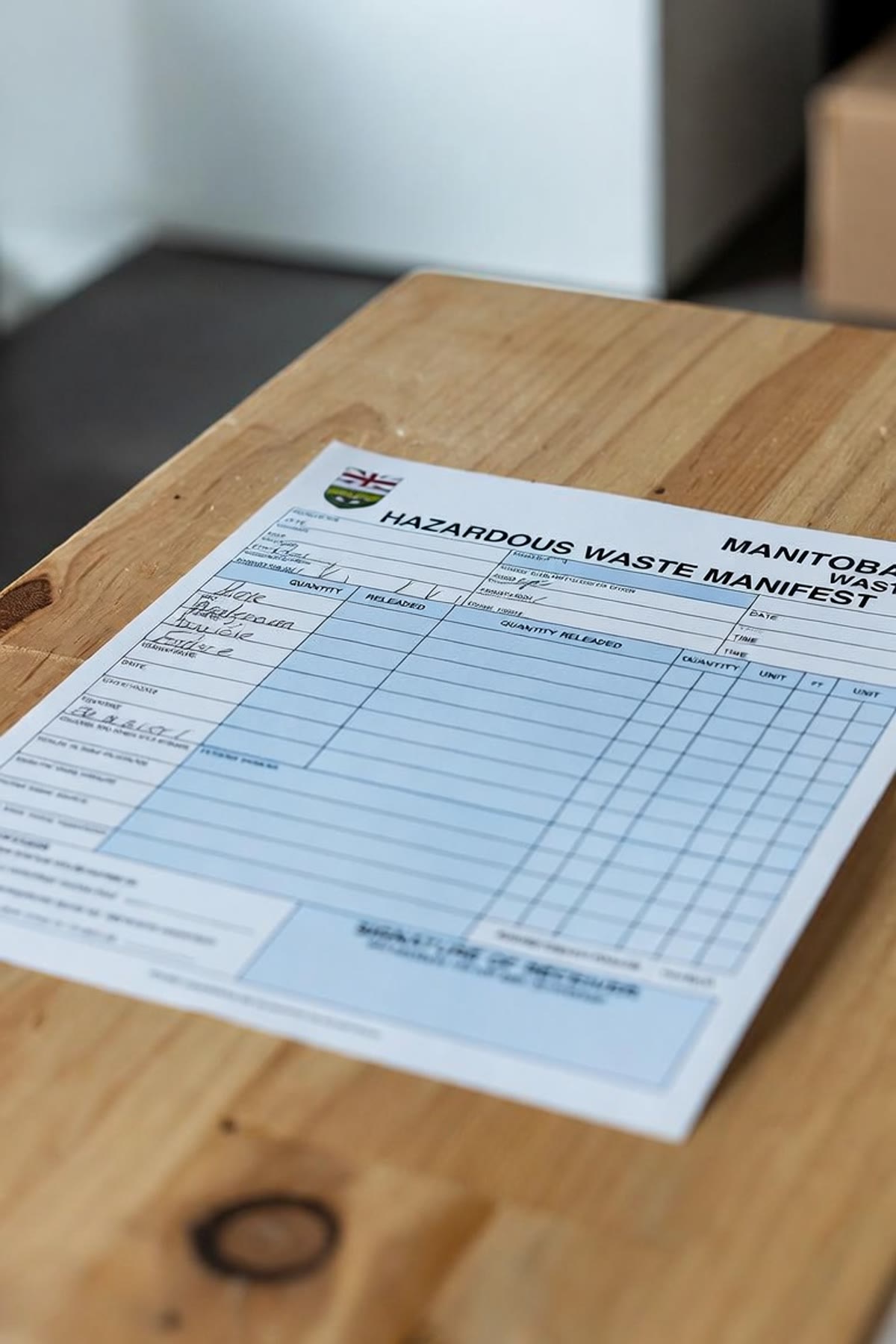
Of all the paperwork that crosses the gate office desk, the hazardous waste manifest is the one that gets the most questions — and the one we're least willing to wave through with a missing signature. Here's what the manifest actually is, why it exists, and what each party in the chain is responsible for.
What a manifest is for
A manifest, sometimes called a movement document, is a tracking form that follows a shipment of hazardous waste from the moment it leaves the generator's site to the moment it's received at an approved disposal or treatment facility. The purpose is straightforward: at any point in the chain, it should be possible to know exactly what's being moved, who generated it, who's carrying it, and where it's going.
In Manitoba, this requirement flows from the Hazardous Waste Regulation, which consolidated what used to be three separate regulations — covering manifesting, generator registration, and carrier licensing — into a single framework. The result is a system built around three roles, each with specific obligations:
1. The generator (consignor)
Anyone who generates hazardous waste above a registrable quantity has to register with the province and receive a generator registration number, sometimes referred to as a Provincial ID. Registration isn't a one-time formality — it has to reflect the actual waste being generated, and changes get reported through a supplementary registration. The generator is also responsible for the first part of the manifest: identifying the shipping name, classification, and packing group for the waste being moved, in line with the Transportation of Dangerous Goods Regulations.
2. The carrier
Hazardous waste can only legally move with a licensed carrier — a company that holds a Licence to Transport Hazardous Waste from Manitoba Environment and Climate Change. Drivers also need training under the federal Transportation of Dangerous Goods Regulations. The carrier's part of the manifest gets filled out, signed, and dated as the shipment changes hands, and the document has to stay with the load — kept in the same location required for shipping documents under the TDG rules — for the entire trip.
3. The receiver (consignee)
The facility that ultimately takes the waste — in our case, a landfill or a downstream treatment site — completes the final section of the manifest on receipt. Licensed disposal facilities also carry an annual reporting obligation, summarizing what they accepted over the year.
Some generators assume a manifest copy needs to be sent to the province every time. In most cases it doesn't — a registered generator typically retains their copy of the movement document for a minimum retention period and produces it on request if an environment officer asks. The exception is for shipments that cross provincial or international borders, which run through a centralized federal system instead.
When a shipment crosses a provincial line
Manifesting gets a second layer of complexity the moment hazardous waste moves between provinces. Interprovincial movements are governed federally, and as of recent amendments, movement documents for these shipments have to be created and submitted through the Canadian Notification and Movement Tracking System (CNMTS) — a centralized electronic system. Paper manifests, faxes, or emailed documents are not accepted for this purpose; the federal system is the system of record.
This matters directly for a site like Virden, which is positioned to receive industrial waste streams from a wide service area. If hazardous waste is arriving from outside Manitoba, the shipment needs:
- A valid generator number from the appropriate authority in the province of origin (Manitoba doesn't issue its own generator numbers to out-of-province operations, but does accept valid out-of-province numbers);
- A CNMTS-tracked movement document with a unique reference number, unless a province-specific exemption applies;
- Compliance with the Transportation of Dangerous Goods Regulations for the actual physical movement, including correct placarding; and
- A receiving facility authorized to accept that waste stream under its own approval.
Each of these steps adds a small amount of friction by design — Transport Canada's own assessment of the expanded interprovincial rules anticipated something in the order of a 10% premium on shipping costs for affected movements, reflecting the additional training, insurance, and documentation carriers now need to carry.
What this looks like in practice at the scale
For a generator or hauler bringing a load to Virden, none of this needs to be intimidating, but it does need to be done in the right order:
- Confirm registration before the truck leaves the yard. A generator number has to exist before a manifest can reference it.
- Use a licensed carrier. An unlicensed transporter, however reliable, can't legally move hazardous waste — and the load can be turned around at the gate as a result.
- Fill out Part A completely before the waste moves. Shipping name, UN number where applicable, classification, and packing group all need to be correct, with the word "waste" added to the shipping description where the regulation requires it.
- Keep the manifest with the load, not in the office. If the document isn't physically present during transport, the shipment isn't in compliance — regardless of how complete the paperwork looks on file.
The manifest exists so that hazardous waste never becomes anonymous between the point it's generated and the point it's safely disposed of. It's a small amount of consistent paperwork in exchange for being able to answer, with certainty, exactly what crossed the gate and where it came from.