
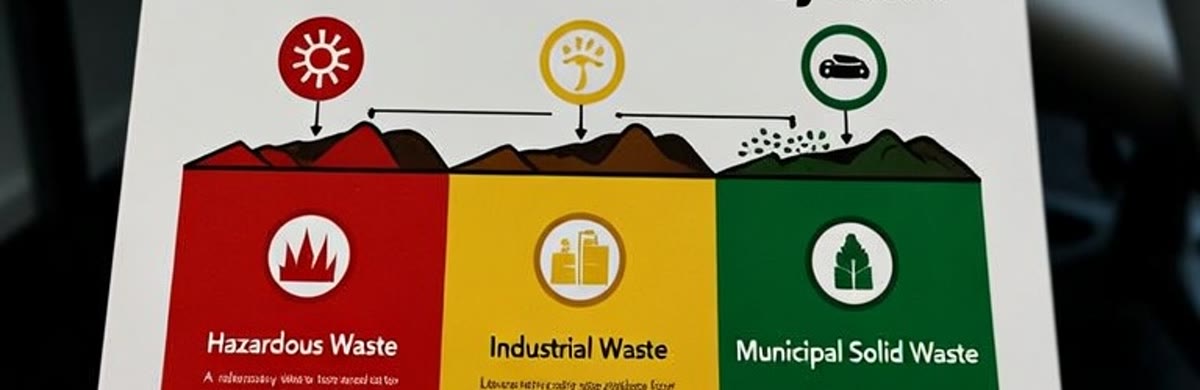
If you've hauled to more than one landfill in Manitoba, you've probably noticed they don't all run the same way. Some take cash at a gate house with a scale. Others are little more than a fenced clearing with posted hours. The difference isn't arbitrary — it's set out in provincial regulation, and it determines almost everything about how a site like Virden operates.
Three classes, one regulation
Manitoba's Waste Management Facilities Regulation divides landfills — formally called Waste Disposal Grounds, or WDGs — into three classes. The classification isn't about size alone, and it isn't optional. It's a legal designation that follows directly from how a site operates and who it serves.
A landfill is classified as Class 1 if it meets any one of the following conditions:
- It receives more than 5,000 tonnes of solid waste in a year, or more than 400 tonnes in any 30-day period;
- It receives solid waste from outside the province; or
- It is operated by anyone other than a municipality or regional waste management authority, and either disposes of waste generated by the operator itself, or accepts waste from others for commercial purposes.
Class 2 WDGs are everything that doesn't meet the Class 1 or Class 3 definition — generally smaller, municipally run sites serving a local population without the tonnage, out-of-province receipts, or commercial third-party operating model that would trigger Class 1 status. Class 3 is a narrower legacy category, carried forward from sites that were already classified that way under the former Waste Disposal Grounds Regulation before the current framework took effect.
The Virden site meets at least two of the three Class 1 triggers on its own terms: it accepts waste generated by a wide range of commercial and industrial sources under a private operating agreement, and its permitted waste streams — including drill cuttings, contaminated soil, and industrial waste — bring material from beyond a single municipality's residential collection. That combination is exactly what the regulation is designed to capture.
What Class 1 actually requires
Classification isn't just a label — it's the gateway to a different tier of regulatory oversight. Class 1 facilities are required to hold an Environment Act Licence, a more rigorous instrument than the permits that can apply to smaller Class 2 sites. Getting or maintaining that licence means going through a public review process, and historically has carried a substantial application fee tied to the proposal.
In practical terms, that licensing structure shapes a lot of what visitors to the Virden site experience day to day:
- Engineered containment. Class 1 sites are expected to operate with a properly designed liner and leachate management system rather than relying on natural soil attenuation alone, particularly where the underlying geology doesn't slow water movement on its own.
- Monitoring obligations. Groundwater and leachate monitoring programs are part of the ongoing licence conditions, not a one-time design exercise.
- Defined waste acceptance criteria. What a Class 1 site is permitted to accept — and what it explicitly is not — is spelled out in its approval, rather than left to informal practice at the gate.
- Closure and post-closure planning. The licence anticipates the full life of the site, including what happens once a cell stops accepting waste.
None of this is unique to Virden. It's the standard that applies to every Class 1 WDG in the province, of which there are a relatively small number compared to the much larger count of Class 2 and Class 3 sites scattered across smaller municipalities.
Geological sensitivity and where a site can sit
One detail worth understanding, because it explains a lot about why landfill siting decisions get made the way they do: the province rates sites for geological sensitivity based on how quickly water moving downward from the surface would reach the aquifer below. A "high" sensitivity rating means that water could reach the aquifer in under 25 years. A "low" rating means it would take 90 years or more.
Sites with a high sensitivity rating aren't automatically disqualified, but the regulation discourages locating there unless the operator is prepared to install a properly designed leachate control system and a suitable liner. This is the regulatory logic underneath a simple operational fact: the liner and the leachate pond aren't just good practice, they're often the specific condition that made a Class 1 licence possible at a given location in the first place.
Why the distinction matters to the people hauling here
For a hauler or a generator, the classification isn't abstract paperwork — it's the reason the gate process at Virden looks the way it does. Weighed loads, posted rates with a provincial levy line item, defined waste-stream categories, and a phone number to call before bringing anything unusual are all downstream of the same regulatory framework. A Class 2 site serving a small rural municipality with a fraction of the tonnage simply isn't required to operate at this level of structure — which is part of why the experience can look so different from one Manitoba landfill to the next.
Understanding which class a site falls under is the first real step in understanding how it operates. Everything else — rates, accepted waste, monitoring, even the questions the gate office asks before letting a load through — follows from that one designation.