
From the air, the most visible structure at a landfill isn't the active disposal cell — it's the lined pond beside it. People sometimes assume that pond is just stormwater. It isn't. It's the leachate containment system, and it's arguably the single piece of infrastructure that the entire site's environmental approval depends on.
What leachate actually is
Manitoba's landfill standards define leachate plainly: it's liquid that has percolated through solid waste and picked up dissolved or suspended material from that waste along the way. Every landfill generates it, because precipitation falls on an active cell whether you want it to or not, and that water has to go somewhere once it's passed through buried material.
The entire purpose of a liner system is to make sure that "somewhere" is a controlled collection point — not the surrounding soil, and not the groundwater beneath it.
What a liner is, technically
Under Manitoba's standards, a liner is defined as a continuous layer — either reworked soil or manufactured material — placed beneath and along the sides of an active waste disposal area, designed to restrict the downward or lateral escape of solid waste, leachate, and gas, while also restricting the upward movement of groundwater into the waste itself. That second part matters as much as the first: a good liner system works in both directions, keeping leachate in and keeping groundwater intrusion out.
The standards also define leachate head specifically — the pressure exerted on the liner by accumulated leachate sitting above it. Managing that head is a core design objective, because a liner under constant high pressure is at far greater risk of long-term failure than one designed to drain efficiently.
Geological sensitivity: why siting and liner design are connected
Not every location starts from the same baseline. Manitoba's standards use a geological sensitivity rating to describe how quickly water moving vertically downward from a site would reach the aquifer:
| Rating | Time for vertical water movement to reach aquifer |
|---|---|
| High | Less than 25 years |
| Moderate | 25 to 90 years |
| Low | 90 years or more |
A high sensitivity rating doesn't automatically rule a site out, but the standards actively discourage building there unless the operator commits to a properly designed leachate control and management system paired with a suitable liner. In other words, the more vulnerable the underlying geology, the more the engineered system has to compensate — and the design submission has to include the supporting calculations and groundwater data to prove it will.
Collection, not just containment
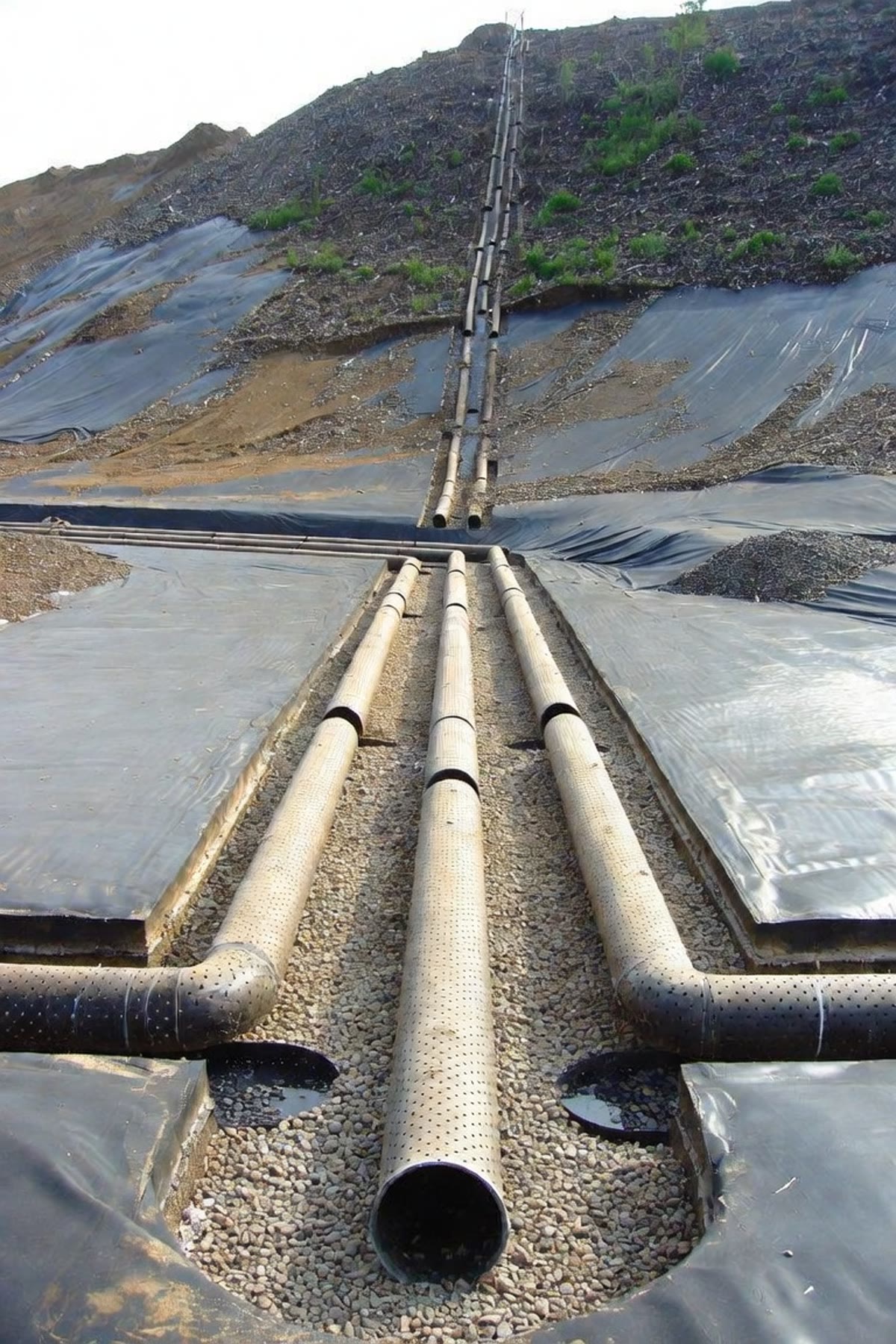
A liner on its own only stops leachate from escaping downward. It still has to be actively collected and managed, which is where the drainage and collection layer comes in. Landfill design standards generally call for a free-draining layer above the liner — built to move leachate toward collection pipes efficiently, rather than letting it pool and build pressure (head) against the liner surface. Collector pipes are typically perforated or slotted and wrapped in protective geotextile to resist clogging over the long operating life of the cell.
From there, collected leachate is routed to a containment pond like the one visible in the Virden site's aerial imagery — itself lined, and itself subject to ongoing monitoring rather than being treated as a passive holding area.
The leachate pond is functionally the last engineered barrier between collected leachate and the surrounding environment before treatment or removal. It's monitored and tested in line with the site's provincial approval — not because the liner system is assumed to be failing, but because verifying that it isn't is the entire point of an ongoing monitoring program.
Monitoring doesn't stop at the liner
Groundwater monitoring wells positioned around a site provide the independent check on whether the liner and leachate system are actually performing as designed. If leachate were migrating past the engineered barrier, groundwater monitoring is what would be expected to detect it — which is why monitoring programs at Class 1 sites are an ongoing licence condition rather than a one-time construction sign-off.
The liner and the leachate pond don't get nearly as much public attention as the active tipping face, but they're the reason a landfill can sit on a piece of land for decades without becoming a long-term liability to the water beneath it. Understanding what they're actually doing — and why the design standards are as specific as they are — makes it a lot easier to understand why a site like Virden operates the way it does.