
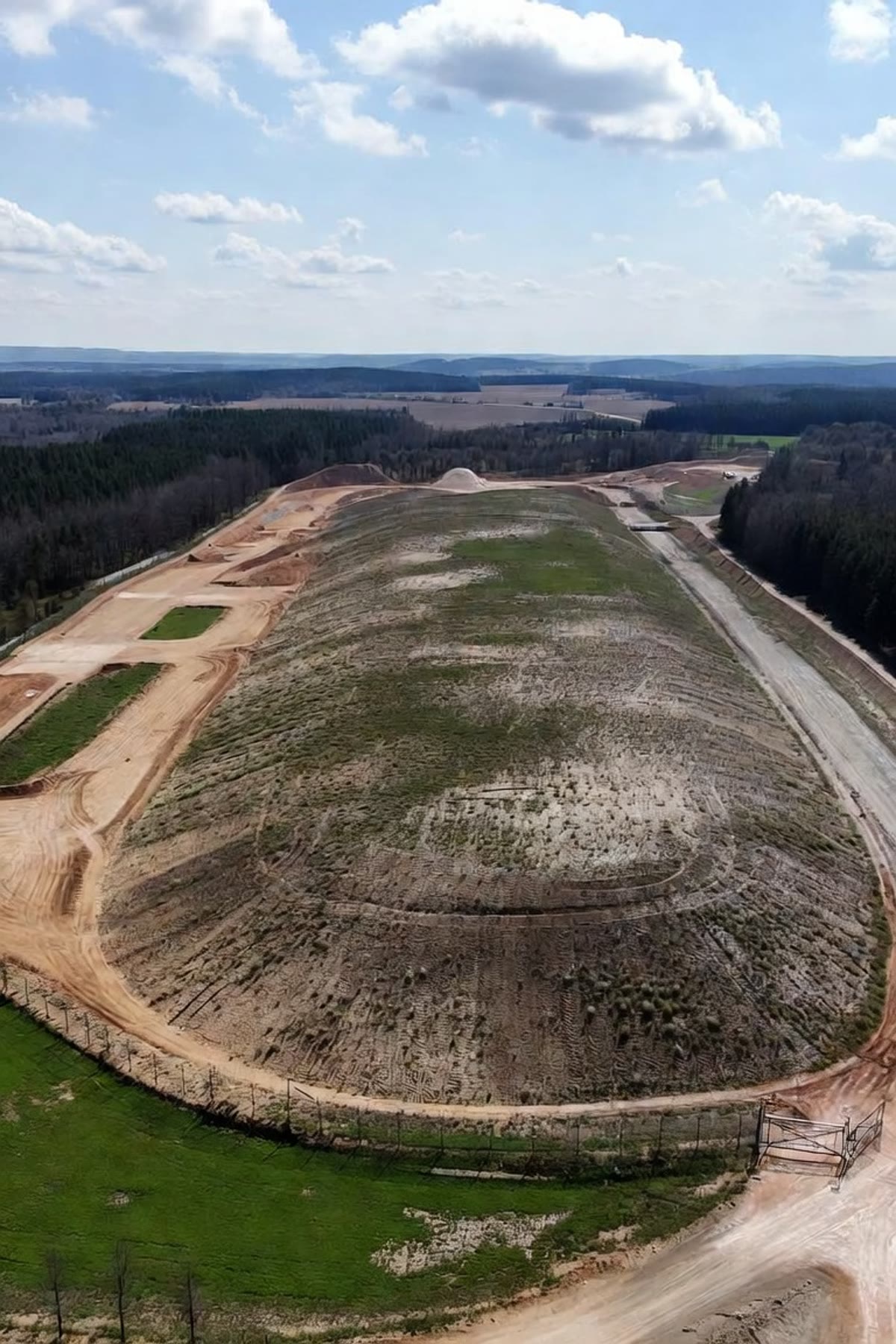
It's easy to think of a landfill cell as finished the day the last truck dumps its load and the area gets capped. In practice, that's closer to the midpoint of the cell's regulatory life than the end of it. Closure is a deliberate engineering process, and post-closure care can run for decades afterward.
Closure isn't just stopping — it's building a final cover
When an active cell or fill phase reaches its approved capacity, it doesn't simply get left alone. A final cover system is constructed over it, and that cover has a specific engineering job to do: minimize the amount of precipitation infiltrating down into the waste, while resisting erosion over the long term.
The design logic behind a final cover is directly connected to the liner sitting beneath the waste. A cover that's too permeable lets water continue infiltrating into the cell indefinitely, which keeps generating leachate that the underlying system then has to keep managing. A cover that's too impermeable relative to the liner underneath it can create the opposite problem — sometimes called the "bathtub effect," where infiltrating water gets trapped between a tighter cover and a more permeable liner, building up hydraulic head and increasing the risk of leachate eventually escaping through the liner rather than draining as designed. Getting that relationship right is one of the more technical aspects of final cover design.
A poorly designed final cover doesn't fail immediately — it fails slowly, often years after closure, which is exactly why post-closure monitoring exists. The cover isn't a one-time construction milestone to check off; it's a long-term component of the same containment system that's been managing leachate since the day the cell opened.
What post-closure monitoring actually involves
Once a cell is closed, the site doesn't stop watching it. A closed cell at a Class 1 facility typically remains subject to:
- Groundwater monitoring, continuing through the same well network used during active operation, to confirm the closed cell isn't becoming a delayed source of contamination;
- Leachate monitoring, since a closed cell can continue generating leachate for years as residual moisture works its way through the buried waste, even after the active tipping has stopped;
- Cover inspection and maintenance, checking for erosion, settling, vegetation establishment, and any cracking that could compromise the cover's performance; and
- Surface water monitoring around the site perimeter, to catch any surface expression of a containment issue before it becomes a larger one.
Why this period is measured in decades, not years
Waste doesn't stabilize on a fixed timeline. Organic material continues decomposing, generating gas and leachate at a declining but real rate for years after burial. Settling continues as buried waste compresses under its own weight and the cover above it. None of these processes follow a clean stop date, which is why post-closure monitoring periods in landfill design are typically planned in multi-decade terms rather than a short administrative window — closer to the kind of long-range planning a site needs when it's also weighing siting decisions against the 25-to-90-year geological sensitivity ratings used at the design stage.
What this means for a site's overall footprint
One practical consequence of long post-closure obligations: a landfill's responsibilities don't shrink as quickly as its active footprint does. A site can have multiple closed cells under ongoing monitoring while a current cell is still actively accepting waste — meaning the total area requiring some form of attention is almost always larger than whatever is visible as "in use" on a given day. This is part of why landfill site plans are built around eventual closure from day one, not treated as an afterthought once capacity runs out.
The long view
For haulers and generators, closure and post-closure care happen well out of sight — there's no part of bringing a load to the gate that touches this directly. But it's worth understanding as context for why a site like Virden is run the way it is throughout its active life. Every liner detail, every leachate monitoring result, and every waste characterization decision made today becomes part of the record that closure planning, and decades of post-closure care, will eventually be built on.
A landfill cell's most active period might only span a few decades. Its monitoring obligations can run considerably longer than that. Understanding closure and post-closure care as part of the same continuous system — not a separate phase that starts once the gates close — is the clearest way to understand why the engineering decisions made on day one matter for as long as they do.