
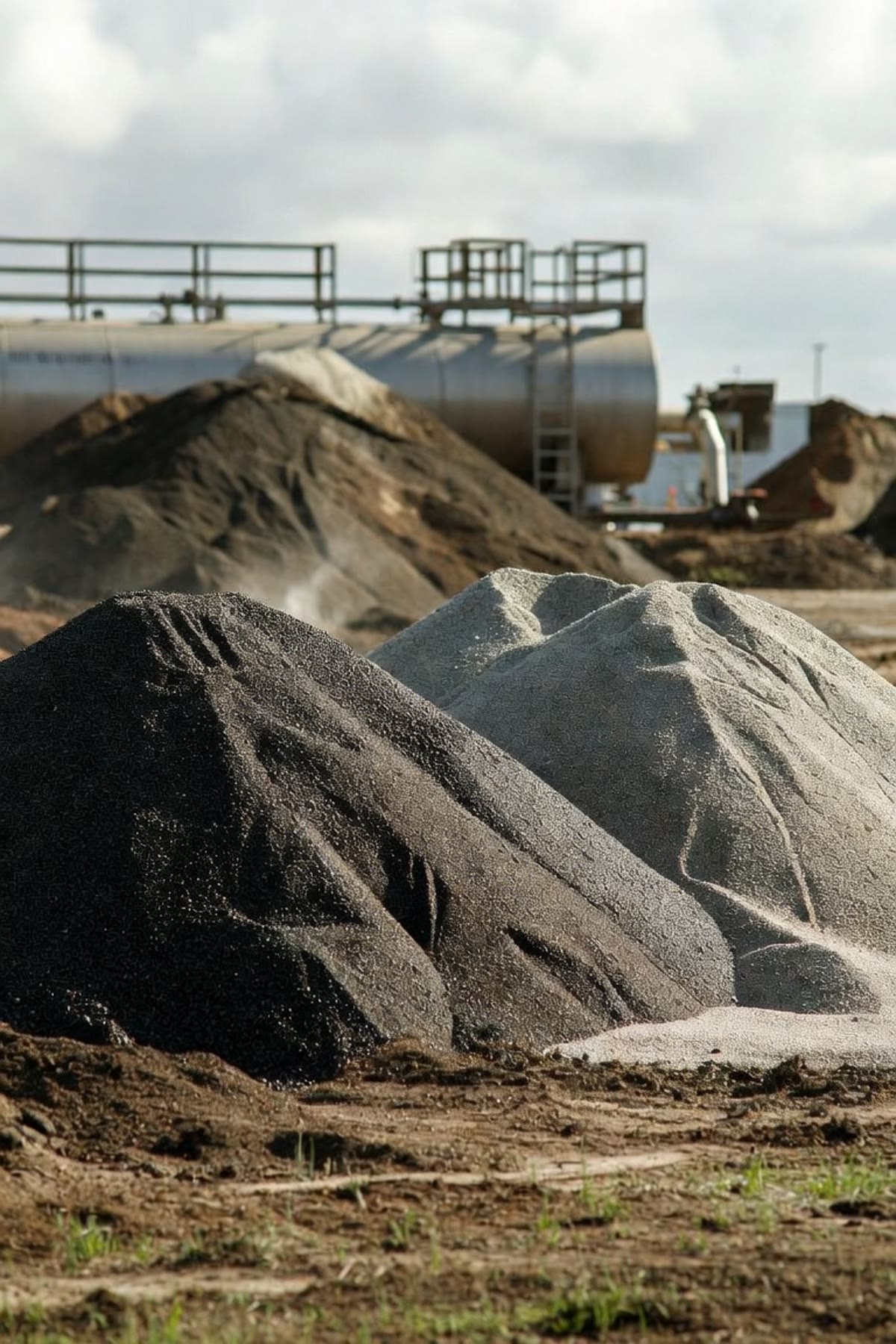
Virden sits in the middle of one of Manitoba's longest-producing oil regions, and that geography shows up directly in the waste streams the local landfill is built to handle. Drill cuttings and produced sand aren't exotic materials here — they're a routine part of the permitted waste list — but they come with their own characterization and handling considerations that are worth understanding if you're generating or hauling them.
What drill cuttings actually are
Drill cuttings are the rock and soil fragments brought to surface during the drilling process, carried up by drilling fluid as the bit advances. They're a direct byproduct of well construction, and their composition depends heavily on the geological formation being drilled through and the type of drilling fluid used. Water-based mud systems generally produce cuttings with a different contaminant profile than oil-based systems, which is part of why characterization matters before a load is brought to any disposal site.
What produced sand is, and why it's different from drill cuttings
Produced sand is a separate waste stream entirely — fine sand and sediment carried up from the formation along with produced oil and water during normal well operation, rather than during drilling itself. It typically gets separated out at surface facilities before the produced fluids move further downstream. Because it's been in contact with formation fluids over the operating life of the well, produced sand can carry residual hydrocarbons and, depending on the formation, naturally occurring radioactive material (NORM) at low concentrations — which is why it's handled and characterized as its own category rather than lumped in with general oilfield debris.
Both drill cuttings and produced sand are accepted at the Virden site as part of its permitted industrial waste streams, but "permitted" doesn't mean automatic. Each load needs to be understood well enough — source well, drilling fluid system, any known NORM concentration — for the gate office to confirm it falls within what the site's approval actually covers.
Why these streams land at an industrial landfill, not a standard one
This connects directly back to Manitoba's landfill classification system. A site that's authorized to accept oilfield waste streams like drill cuttings and produced sand is, by definition, operating outside the scope of an ordinary municipal Class 2 site. These materials carry contaminant profiles that a smaller residential-focused landfill's design — liner, leachate system, monitoring program — was never built to manage. Class 1 sites are engineered with that broader range of inputs in mind from the start, which is exactly why oilfield waste streams concentrate at facilities like Virden rather than spreading across every landfill in the region.
What generators and haulers should have ready
- Source identification. Which well or facility generated the material, and roughly what volume is involved.
- Drilling fluid system, for cuttings specifically. Water-based and oil-based systems carry different handling expectations, and the gate office needs to know which applies.
- Any known NORM data, for produced sand. If the producing formation or facility has existing radiological screening data, having it on hand speeds up the acceptance conversation considerably.
- Confirmation the load hasn't been mixed with anything else. Combining drill cuttings with general construction debris, or produced sand with unrelated industrial waste, complicates characterization for no operational benefit — keep oilfield streams separate from everything else.
The bigger picture: oilfield waste as a regional service
Western Manitoba's producing wells don't generate waste in isolation — they generate it as part of a service area that depends on having a properly engineered disposal point within a reasonable haul distance. That's part of the practical reasoning behind a Class 1 site's broader waste acceptance list: without a facility purpose-built to take drill cuttings and produced sand close to where they're generated, that material would need to travel substantially farther, at real added cost and emissions, to reach an equivalent facility elsewhere.
Drill cuttings and produced sand aren't unusual loads at Virden — they're part of why a site like this exists in this specific location in the first place. Treating them as routine, properly characterized waste streams, rather than an afterthought bolted onto a municipal landfill, is exactly what the site's design and its approval are built around.