
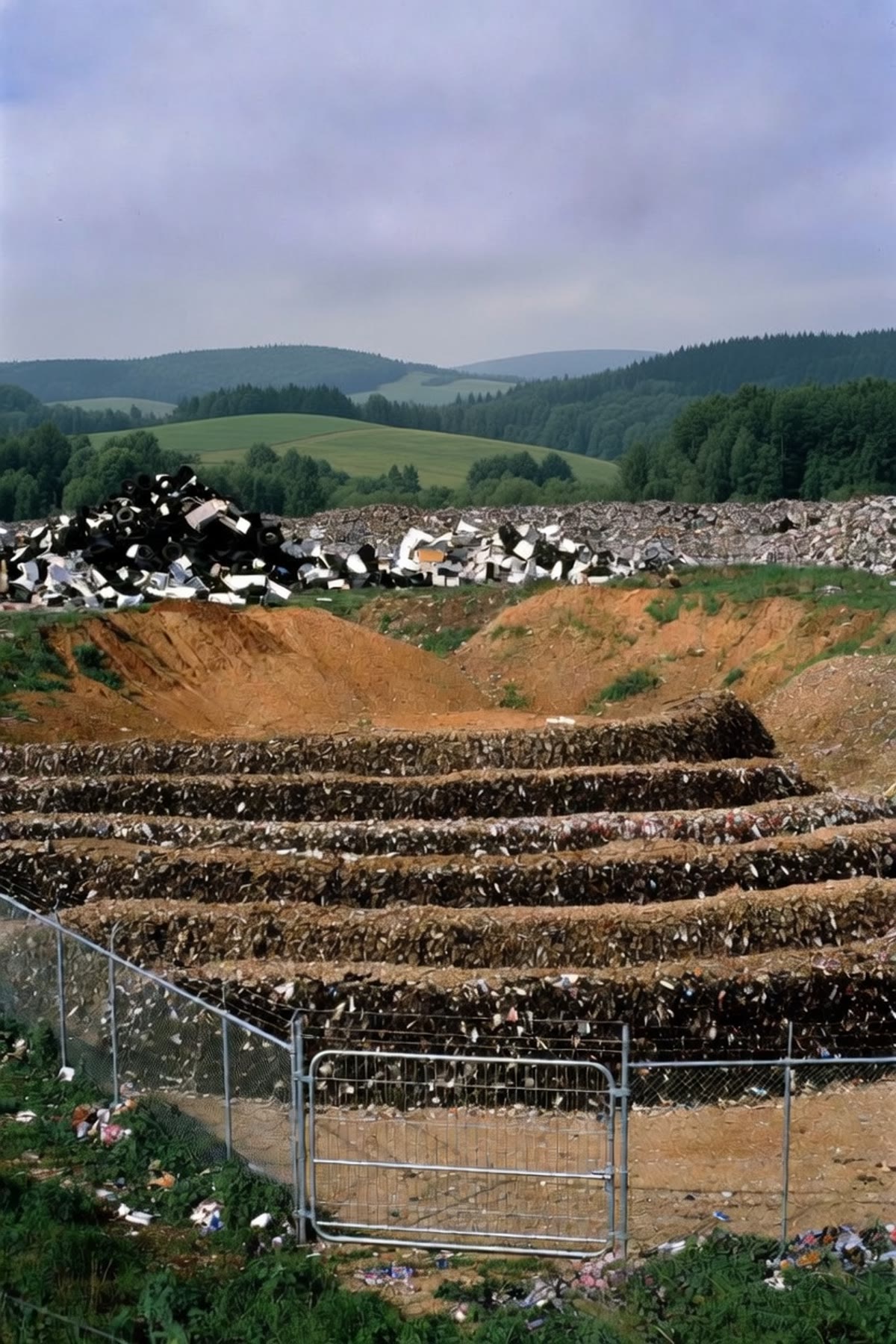
"It's just garbage" is a phrase we hear at the gate more often than you'd think, usually attached to a load that turns out to be anything but ordinary household refuse. The distinction between municipal solid waste (MSW) and industrial waste isn't a technicality — it changes what a site is legally permitted to bury, how it's priced, and how it has to be handled once it's on the ground.
What separates the two categories
Municipal solid waste is, broadly, the waste stream generated by households and typical municipal collection — household garbage and refuse, wood and paper, shingles, and general construction and demolition debris fall into this bucket at most sites, including Virden's posted rate card. It's relatively predictable in composition and, while it absolutely requires proper handling, it doesn't usually carry the same characterization burden as industrial waste.
Industrial waste is everything generated as a byproduct of an industrial, commercial, or resource-extraction process — and it's far more variable. At the Virden site specifically, the permitted industrial streams include drill cuttings, produced sand, contaminated soil, cement, and broader industrial waste categories. Each of these can carry contaminants, chemical residues, or physical properties that household refuse simply doesn't.
Why the same shovel-full isn't priced the same
This is the part that catches people off guard: two loads that look superficially similar at the gate can be billed at completely different rates, because the rate card isn't really pricing volume — it's pricing risk and handling burden. Scrap iron and tires are billed at a flat per-tonne rate regardless of provincial levy, while household garbage, construction and demolition debris, and wood and paper all carry an additional $10.00 per tonne provincial levy layered on top of the base rate. Appliances are priced per unit rather than by weight, because the handling concern (refrigerants, in particular) doesn't scale neatly with mass.
Industrial waste streams that fall outside the standard posted categories — drill cuttings, contaminated soil, asbestos, and similar materials — generally aren't priced off a simple public rate card at all. They're priced and scheduled based on a conversation with the gate office about volume, characterization, and any special handling required, which is exactly why we ask haulers to call ahead for anything in that category rather than just showing up.
Characterization is the real difference
The deeper reason MSW and industrial waste are treated differently comes down to a concept called waste characterization — understanding what's actually in a load before it goes into the ground. For straightforward household refuse, characterization is largely assumed based on the source. For industrial waste, it isn't assumed at all.
Depending on the waste stream, characterization can involve testing for things like pH, reactivity, the presence of specific contaminants, or whether the material would produce a leachable concentration of a regulated substance above an acceptable threshold. This is the same underlying logic that separates hazardous from non-hazardous waste under provincial regulation — the question isn't what something is called, it's what it will actually do once it's in contact with water moving through a landfill cell over decades.
If a waste stream came from an industrial, commercial, or extraction process rather than a household, assume it needs a conversation with the gate office before it needs a truck. The cost of a phone call is nothing. The cost of a rejected load — or worse, an accepted load that shouldn't have been — is considerably more.
What happens when the categories get mixed
One of the most common complications at any gate is a load that blends categories — construction debris with embedded asbestos siding, demolition waste contaminated with an industrial chemical from the building's prior use, or contaminated soil mixed in with otherwise clean fill. Mixed loads don't get to default to the least restrictive category. They get handled according to the most restrictive material present, which is exactly why pre-sorting on a job site, before material ever reaches a truck, saves both time and money at the scale.
Why this distinction protects everyone, not just the regulator
It's tempting to see the MSW/industrial distinction as bureaucratic friction, but it exists for a structural reason: a landfill's leachate management system, liner design, and monitoring program are all sized and engineered around an expected waste composition. Letting industrial waste move through the gate under an MSW assumption doesn't just risk a compliance problem — it risks introducing something the engineered containment system wasn't actually designed to handle.
The clearest way to think about it: MSW and industrial waste aren't two prices for the same thing. They're two different categories of risk, and the rate card, the intake questions, and the call-ahead policy all exist to make sure each load ends up handled the way its actual composition requires.